Apostille vs Legalization: Which One Do You Need?

Apostille vs Legalization: Which One Do You Need?

If your destination country belongs to the Hague Apostille Convention, you need an apostille. If it does not, you need embassy or consular legalization. That is the core difference between legalization and apostille. Your first action: check the HCCH contracting parties list to confirm your destination country’s status, then contact the right U.S. issuing office or reach out to Premier Notary & Apostille Services for guided help.
Table of Contents
- What is an apostille and what gives it legal authority?
- What is legalization and when do you need it?
- Which countries accept apostilles and which require legalization?
- Apostille vs legalization: a quick side-by-side comparison
- How to get an apostille for U.S. documents
- How to get U.S. documents legalized for non-Hague countries
- What document types need apostilles or legalization?
- Typical timelines, fees, and mistakes that cause rejections
- A quick checklist for deciding which route you need
- How Premier Notary & Apostille Services can help you get it right
- Key Takeaways
- The case for getting professional help sooner rather than later
- Premier Notary & Apostille Services is ready to process your documents
- Useful sources to check before you submit
- FAQ
What is an apostille and what gives it legal authority?
An apostille is a single-step certificate issued under the 1961 Hague Apostille Convention that confirms the authenticity of a signature, seal, or the official capacity of the person who signed a public document. The Convention currently has 130 Contracting Parties and replaced the old multi-step legalization chain between member countries with one standardized certificate. An e-Apostille option also exists for electronically issued documents and carries the same legal weight as a paper apostille.
For U.S. documents, who issues the apostille depends on where the document originates:
- State-issued documents (birth certificates, marriage certificates, state court orders, notarized documents): the Secretary of State of the issuing state is the designated Competent Authority.
- Federally issued documents (federal court records, documents from federal agencies): the U.S. Department of State’s Office of Authentications issues the apostille.
- What apostilles do NOT certify: they confirm signature authenticity and official capacity only. They do not validate the content, accuracy, or truthfulness of the document itself.
That last point matters more than most people realize. An apostilled transcript does not mean the grades are verified. It means the registrar’s signature is authentic.
What is legalization and when do you need it?
Legalization is a multi-step consular process used when the destination country is not a member of the Hague Apostille Convention and therefore does not accept apostilles. Instead of one certificate, you work through a chain of authentications before the foreign embassy or consulate applies its own stamp.
The required sequence for U.S. documents going to a non-Hague country:
- State-level authentication (for state-issued documents): the issuing state’s Secretary of State authenticates the document first.
- U.S. Department of State authentication: the federal authentication step. This cannot be skipped — the destination embassy will not legalize a document that has not already been authenticated at the federal level.
- Foreign embassy or consulate legalization: the destination country’s embassy or consulate in the U.S. applies the final legalization stamp.
Like apostilles, legalization certifies signature authenticity and the legitimacy of the signing authority. It does not certify the content of the document.
Pro Tip: Confirm the destination embassy’s specific checklist before you submit anything. Some embassies require separate application forms, certified translations, or local fees that are not listed on general guidance pages. Getting this wrong at step three means restarting the chain.

Which countries accept apostilles and which require legalization?
The rule is straightforward: apostilles are only valid between countries that are both parties to the 1961 Hague Convention. If your destination country is on the HCCH contracting parties list, an apostille is sufficient. If it is not, you need the full authentication and consular legalization chain.
Steps to confirm which route you need:
- Visit the HCCH website and check the current contracting parties list for your destination country.
- Check the destination country’s embassy or consulate website in the U.S. for any document-specific exceptions.
- Look for bilateral agreements that may exempt certain document types from standard requirements.
- Note that some countries accept apostilles for private documents but require legalization for specific categories (commercial or court documents, for example).
- Territories and dependencies sometimes have rules separate from the parent country — verify the specific territory, not just the country name.
The U.S. is a party to the Hague Apostille Convention, so U.S.-issued documents can receive apostilles for use in any other member country. Countries that commonly require full legalization include China, Saudi Arabia, and several other non-Hague nations — always verify current status since membership can change.
Apostille vs legalization: a quick side-by-side comparison
Two factors drive the decision more than anything else: whether the destination country is a Hague member, and whether your document is state-issued or federally issued. Here is how the two routes compare across the dimensions that matter most.
| Dimension | Apostille | Embassy Legalization |
|---|---|---|
| When to use | Destination country is a Hague Convention member | Destination country is NOT a Hague Convention member |
| Issuing authority | State Secretary of State (state docs) or U.S. Dept. of State (federal docs) | State auth → U.S. Dept. of State auth → foreign embassy/consulate |
| Number of steps | Single step | Three steps (state, federal, embassy) |
| Typical timeline | Days to a few weeks depending on state | Several weeks to months |
| Cost factors | State fee + shipping | State fee + federal fee + embassy fee + possible translation |
| Common document types | Birth/marriage certificates, diplomas, notarized POAs, state court orders | Same document types, but destined for non-Hague countries |
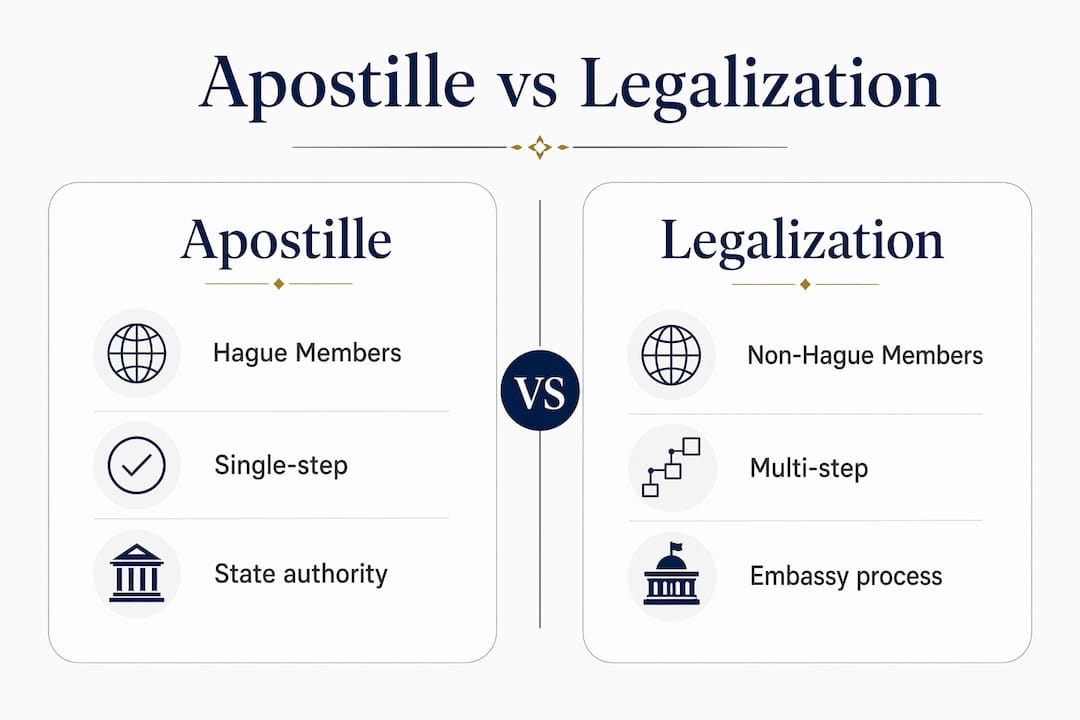
For a deeper look at how these two routes compare in practice, the distinction between state and federal origin is the most common source of confusion.
How to get an apostille for U.S. documents
The process splits cleanly between state-issued and federally issued documents. Mixing up the issuing authority is one of the most common reasons apostille requests get rejected or delayed.
State-issued documents
- Confirm you have the correct document type: an original or a certified copy issued by the state agency (not a photocopy).
- Check whether notarization is required. Some documents (like notarized powers of attorney) already carry a notary seal; others (like certified birth certificates) do not need additional notarization.
- Submit to the Secretary of State of the state that issued the document. Each state has its own form, fee schedule, and processing time.
- Include the required fee (varies by state), a self-addressed return envelope or prepaid shipping label, and any state-specific cover form.
- Choose standard or expedited processing. Many states offer expedited options for an additional fee.
Federally issued documents
For federal documents, submit to the U.S. Department of State’s Office of Authentications in Washington, D.C. The submission checklist is similar: original or certified copy, completed DS-4194 form, correct fee, and return shipping. Processing times at the federal level can run longer than state offices, so plan accordingly.
Submission checklist for both routes:
- Original document or certified copy (not a photocopy)
- Correct notarization if required by the issuing authority
- Completed application form for the relevant office
- Payment for the applicable fee
- Prepaid return envelope or shipping label
- Any required cover letter specifying the destination country
How to get U.S. documents legalized for non-Hague countries
The legalization chain has a strict order. Skipping any step blocks the next one — the foreign embassy will not process a document that has not already cleared both the state and federal authentication steps.
- State authentication: submit the document to the Secretary of State of the issuing state. This step authenticates the notary’s or official’s signature on the document.
- U.S. Department of State authentication: send the state-authenticated document to the Office of Authentications. This is the federal layer that the embassy requires before it will act.
- Foreign embassy or consulate legalization: submit the fully authenticated document to the destination country’s embassy or consulate in the U.S. Each embassy sets its own fees, forms, and appointment requirements.
For the embassy step, requirements vary significantly. Some embassies require certified translations, specific application forms, or in-person appointments. Fees are set by each embassy and can change without notice.
Pro Tip: Call or email the destination embassy before you start the chain. Ask for their current checklist, confirm whether appointments are required, and save any written confirmation they provide. Embassy-specific rules are the most common source of last-minute surprises.
Using a professional service for legalization is worth considering when timelines are tight, documents are complex, or you are unfamiliar with a particular embassy’s process. The authentication vs apostille distinction also matters here — authentication is a step within legalization, not a synonym for it.
What document types need apostilles or legalization?
Most personal and business documents fall into predictable categories. The key variable is always the same: where was the document issued (state or federal), and where is it going (Hague or non-Hague country)?
- Birth and marriage certificates: state-issued vital records. Apostille from the issuing state’s Secretary of State for Hague destinations; full legalization chain for non-Hague destinations.
- Diplomas and academic transcripts: typically issued by a private institution, so they usually require notarization first, then the apostille or authentication step. For the difference between diploma apostille and notarization, notarization comes before the apostille — it is not a substitute for it.
- Powers of attorney: notarized by a licensed notary, then apostilled or authenticated. The notary’s signature is what the apostille or authentication certifies.
- Corporate and commercial documents: articles of incorporation, certificates of good standing, and similar records are often state-issued. They follow the same state apostille route, though some corporate documents may require additional certification steps.
- Court orders and judgments: issued by state or federal courts. State court orders go through the state Secretary of State; federal court documents go through the U.S. Department of State.
Quick prep notes: always use originals or certified copies, never photocopies. If a translation is required, use a certified translation professional and confirm whether the translation itself needs to be notarized before submission. Apostilles and legalizations have no expiration date, but if the underlying document has a limited validity period, that limit applies.
Typical timelines, fees, and mistakes that cause rejections
Processing times vary by office and volume. State apostille offices typically process requests in a few business days to a few weeks; expedited options are available in most states for an additional fee. Federal apostilles through the U.S. Department of State can take longer. Full legalization adds the embassy step, which can extend the total timeline to several weeks or more depending on the destination country’s embassy workload and appointment availability.
Fees stack up across the chain: state fees, federal fees, embassy fees, translation costs, and shipping. There is no single flat fee — each step has its own charge.
The HCCH Apostille Convention was designed to simplify cross-border document use between its many Contracting Parties by replacing multi-step legalization with a single apostille certificate.
Common mistakes that cause delays or rejections:
- Submitting a photocopy instead of an original or certified copy
- Notarizing a document that does not need notarization, or notarizing it incorrectly
- Sending a state document to the federal office (or vice versa)
- Skipping the state authentication step before the federal step in a legalization chain
- Submitting untranslated documents when the destination requires a certified translation
- Assuming an apostille is valid for a non-Hague country
- Missing embassy-specific forms or fees at the consular legalization step
If a document is rejected, identify which step failed, correct only that step, and resubmit. You do not always need to restart the entire chain.
A quick checklist for deciding which route you need
Work through these steps before you submit anything:
- Check the HCCH contracting parties list for your destination country. If it is listed, you need an apostille. If not, you need the full legalization chain.
- Identify whether your document is state-issued or federally issued. This determines which U.S. office handles your request.
- Read the destination embassy’s current guidance for any document-specific exceptions or additional requirements.
- Confirm whether a certified translation is required and whether it needs to be notarized.
- Decide whether you need expedited processing and choose authenticated shipping for high-value documents.
If you are unsure about any step, the right move is to contact a professional service before submitting. Complex documents, urgent timelines, and unfamiliar embassy rules are the three situations where professional help saves the most time and reduces rejection risk.
How Premier Notary & Apostille Services can help you get it right
Premier Notary & Apostille Services handles the full range of document authentication needs: notarization, apostille processing for state and federal documents, and support for embassy legalization workflows. The guided intake process walks you through exactly what is needed for your specific document type and destination country, reducing the risk of errors that cause rejections.
Same-day processing options are available for time-sensitive situations. Whether you need a notarized affidavit prepared before an apostille submission or guidance on the legalization chain for a non-Hague destination, the team is set up to support both personal and business clients. For an apostille vs embassy legalization question specific to your documents, Premier Notary & Apostille Services can clarify the right route quickly.
Key Takeaways
If your destination country is a Hague Convention member, get an apostille from your state Secretary of State or the U.S. Department of State; if it is not, complete the full state authentication, federal authentication, and embassy legalization chain before submitting abroad.
| Point | Details |
|---|---|
| Core decision rule | Hague member country = apostille; non-Hague country = state auth + federal auth + embassy legalization. |
| Who issues apostilles in the U.S. | State Secretary of State for state documents; U.S. Department of State for federal documents. |
| Legalization requires all steps | Skipping state or federal authentication blocks the embassy from legalizing the document. |
| What neither process certifies | Apostilles and legalizations confirm signature authenticity only, not the content of the document. |
| Premier Notary & Apostille Services | Offers same-day processing, guided intake, and support for both apostille and legalization workflows across over 1,900 documents processed. |
The case for getting professional help sooner rather than later
Most people underestimate how much the embassy step in legalization can vary. Two documents going to the same country can have different requirements depending on document type, and embassy checklists change without public notice. The apostille route is more predictable, but even there, state offices have different forms, fees, and processing windows that catch people off guard.
For a straightforward apostille on a birth certificate with several weeks of lead time, the DIY route through your state Secretary of State is entirely manageable. For anything involving embassy legalization, a tight deadline, or multiple document types, professional intake is worth the cost. The guided intake process at Premier Notary & Apostille Services catches the preparation errors — wrong document type, missing notarization, incorrect certified copy — before they become rejections. Same-day options mean urgent situations do not have to derail plans.
Premier Notary & Apostille Services is ready to process your documents
Apostille or legalization, Premier Notary & Apostille Services handles both. With same-day processing options and a guided intake process, you get clear direction on exactly what to submit and where, without the back-and-forth of figuring it out alone.
Book notarization for your documents before the apostille or authentication step at the affidavit notarization booking page, or get started with passport document notarization for international travel needs. Over 1,900 documents processed. 5-star Google reviews. Contact Premier Notary & Apostille Services to confirm your document type and get the right process started today.
This article is general information, not legal advice. Confirm current requirements with the relevant issuing authority, destination embassy, or a qualified professional for your specific situation.
Useful sources to check before you submit
Official sources change their requirements. Verify current rules on each of these before submitting any document.
- HCCH Apostille Section: check the current contracting parties list, e-Apostille program details, and the designated Competent Authority for each country.
- U.S. Department of State — Apostille Requirements: federal apostille steps, the DS-4194 form, and preparation guidance for federal documents.
- U.S. Department of State — Authentication Services: the federal authentication chain for non-Hague destinations and what the Office of Authentications requires.
- USA.gov — Authenticate a U.S. Document: plain-language overview of both apostille and legalization routes for U.S. documents.
- Your state Secretary of State office: each state posts its own apostille form, fee, and processing time. Search “[your state] Secretary of State apostille” for the current page.
- Destination country’s embassy or consulate in the U.S.: the only authoritative source for that country’s legalization requirements, translation rules, and appointment procedures.
Always confirm translation requirements with the destination embassy before submitting. For documents that require a certified translation, working with legal document translation specialists reduces the risk of rejection at the embassy step.
Save screenshots and any written confirmation the embassy provides. Embassy guidance given verbally can be difficult to verify later if a question arises during processing.
FAQ
What is the difference between an apostille and legalization?
An apostille is a single-step certificate for use in countries that belong to the Hague Apostille Convention; legalization is a multi-step process (state authentication, federal authentication, then embassy stamp) required for non-Hague countries.
Can a notary do an apostille?
No. A notary public prepares or witnesses a document, but the apostille itself is issued by a designated government authority: the state Secretary of State for state documents, or the U.S. Department of State for federal documents.
What does it mean to have a document legalized by apostille?
It means a Competent Authority has attached an apostille certificate confirming the authenticity of the signature and the official capacity of the signer. It does not certify the content of the document itself.
What are common apostille mistakes to avoid?
The most frequent errors are submitting a photocopy instead of a certified copy, sending a state document to the federal office, and assuming an apostille is valid for a non-Hague destination country. Confirming the correct issuing authority and document type before submission prevents most rejections.
When should you use a professional service for apostilles or legalization?
Use a professional service like Premier Notary & Apostille Services when your timeline is tight, your documents involve embassy legalization, or you are unsure which authentication chain applies. Same-day processing options and guided intake reduce the risk of errors that cause delays.